
Accident Involving a Patient? How to Handle Insurance, Facilities, and Family Pressure
Multi-Party Incidents & Communication Control: Managing Exposure with Clarity and Discretion
When an incident involves a patient, particularly in medical transportation or healthcare settings, multiple parties often become involved simultaneously. This can include the patient’s family, the receiving facility, regulatory stakeholders, and one or more insurance carriers, each with their own concerns, expectations, and communication style. As these interactions unfold, the situation can quickly become complex and difficult to manage without a centralized, disciplined approach.
In these moments, the issue is no longer just the incident itself, it becomes how the incident is communicated, interpreted, and ultimately defined.
Providers are often placed in a position where they must respond quickly to a high volume of inquiries, many of which are emotionally charged or based on incomplete information. Families may be seeking immediate answers. Facilities may be requesting reports or clarification. Insurance carriers may begin gathering details for claims evaluation. At the same time, documentation is still being assembled, timelines are still being confirmed, and not all facts are fully known.
Without structure, this creates risk.
Overlapping communication, repeated requests, and informal responses can lead to inconsistencies—small variations in language or detail that, over time, can be interpreted as contradictions. Even well-intentioned transparency can become problematic if information is shared prematurely, without context, or without alignment across all parties.
This is where discretion becomes critical.
Acting with discretion does not mean withholding information or avoiding accountability. It means ensuring that communication is accurate, consistent, and appropriately timed. It means understanding that every statement—whether verbal or written—can be referenced, revisited, and potentially reframed as the situation evolves.
In high-sensitivity situations, there is often an additional layer of exposure.
Incidents involving patients can attract outside attention, including legal inquiries or third-party representation. In some cases, narratives may begin to form quickly, before all facts are established. Early communications—particularly those made under pressure or without full context—can be selectively interpreted or used to support positions that do not fully reflect the reality of the event.
This creates a delicate balance:
Providers must be transparent and responsive, while
Also being measured, deliberate, and protective of their position
Responding too slowly can create concern or distrust. Responding too quickly, or without structure, can introduce unnecessary exposure.
We help providers navigate this balance.
Our approach centers on centralizing communication and controlling how information is released. We work to organize documentation, establish a verified timeline, and ensure that all outbound communication reflects a consistent and accurate position. This includes aligning internal understanding before external responses are issued, reducing the risk of fragmented or conflicting narratives.
We also help providers:
Identify when additional clarification is needed before responding
Structure responses that are clear, factual, and non-speculative
Maintain consistency across communications with families, facilities, and carriers
Avoid unnecessary disclosures that do not advance resolution but increase exposure
Recognize when a situation may be evolving beyond routine communication into a more formal or adversarial posture
Importantly, this approach allows providers to remain both professional and protected.
Transparency does not require overexposure. Responsiveness does not require reactivity. And cooperation does not require relinquishing control.
In multi-party incidents, the outcome is often influenced as much by how the situation is communicated as by the underlying facts themselves. Providers who approach these situations with structure, discipline, and discretion are far better positioned to manage expectations, preserve credibility, and reduce both legal and reputational risk.
We help you remain clear, consistent, and in control, so you can navigate complex situations with confidence, not uncertainty.
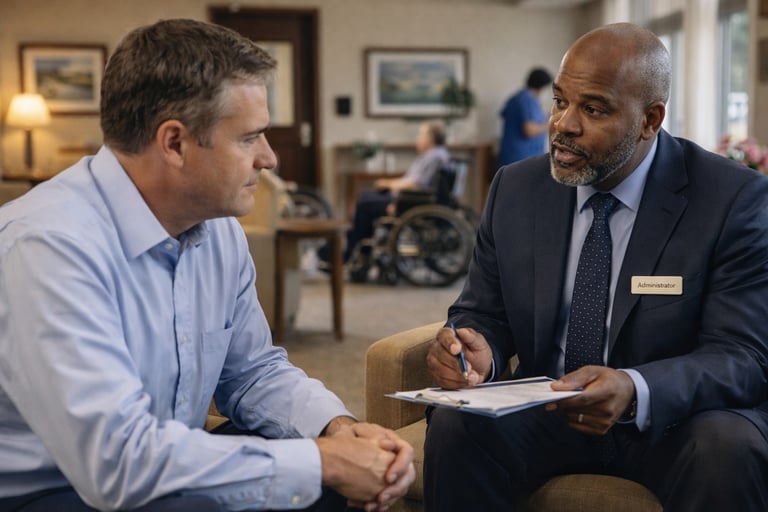

In multi-party incidents, how you communicate matters just as much as what happened. Clear, consistent, and coordinated communication is critical to maintaining trust, reducing confusion, and protecting your position as multiple stakeholders become involved. We are dedicated to helping you stay aligned, in control, and strategically positioned, so you further limit your exposure to risk and liabilities. Your actions, your conversation, either supports or hurt the outcome.
Office of Corporate compliance & Legal Affairs
Compliance@Compliance-RiskManagement.com
© 2025. All rights reserved.
2207 Concord Pike, Suite 375
Wilmington, DE 19803